 BedBear
Set your wake times
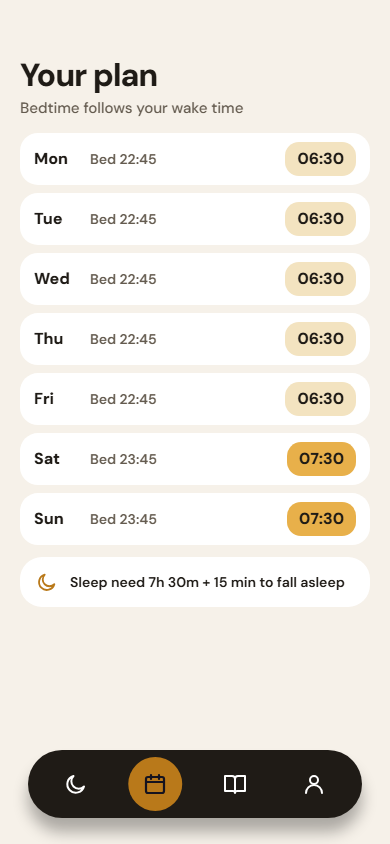
Pick a wake time for each weekday and how much sleep you need. BedBear works out tonight's bedtime: wake time minus sleep need minus 15 minutes to fall asleep.
BedBear turns your wake time into tonight's bedtime, walks you through a calm wind down routine and stays kind when you're late. No lockouts. No guilt. Just more sleep.
Free to download for iPhone and Android. Available in 15 languages.
Up at 6:30 AM − 7h 30m sleep − 15 min to fall asleep
After a long day, the quiet hours feel like the only time that belongs to you. So you stay up. Again. Most late nights start with one of these:
Three steps, set up in two minutes. Bjørn the bear does the maths and the reminding.
Pick a wake time for each weekday and how much sleep you need. BedBear works out tonight's bedtime: wake time minus sleep need minus 15 minutes to fall asleep.
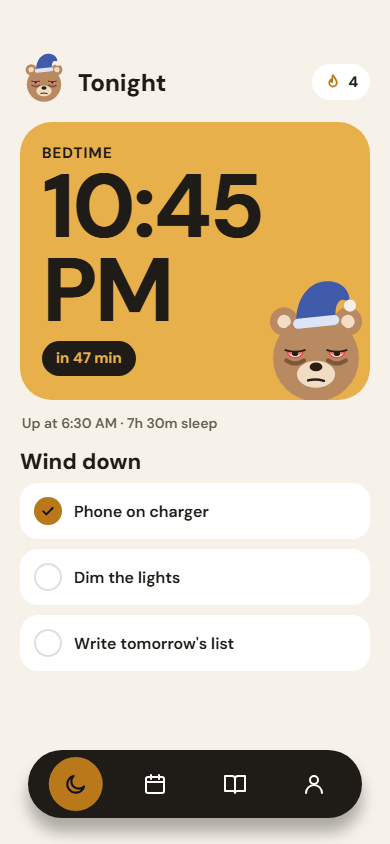
Dim the lights 47 minutes before bed, put your phone on the charger at 30, and read a few pages at 15. A wind down routine that's small enough to actually do.
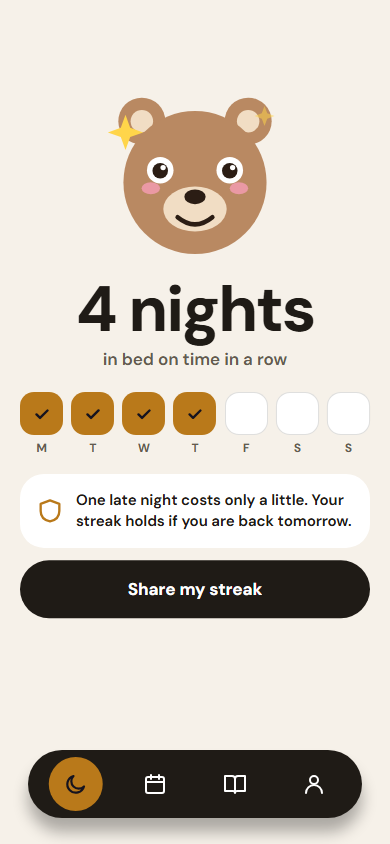
When it's time, hold the button for two seconds to say you're going to bed. Each on-time night grows your streak, and you can share it when you're proud.
 32 min
No need to open the app. BedBear counts down on your lock screen and in the Dynamic Island, and you can tick off each step with one tap.
On Android, the same wind down shows as an ongoing notification card.
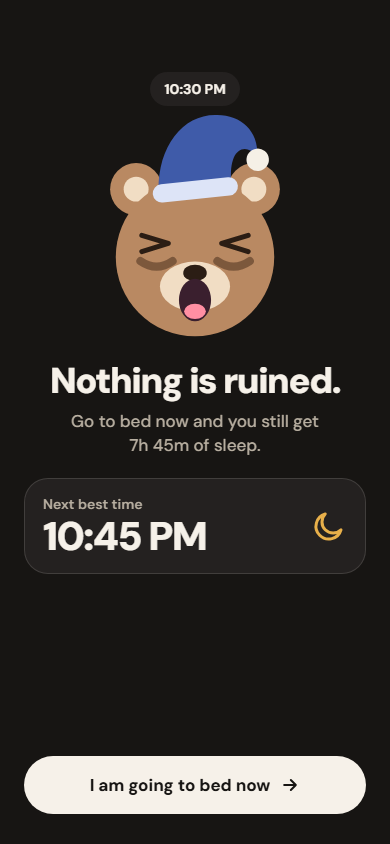
Most sleep apps treat a late night like a failure. BedBear doesn't. It shows your next best time and how much sleep you still get, so going to bed now always feels worth it.
BedBear is new, so we won't show you reviews we don't have yet. Here is the research that shaped it.
US adults usually sleep less than the recommended 7 hours a night (34.8% in a survey of over 444,000 adults).
Liu Y. et al. (2016). Prevalence of Healthy Sleep Duration among Adults, United States, 2014. CDC, Morbidity and Mortality Weekly Report 65(6).The researchers who named "bedtime procrastination" found it strongly linked to getting too little sleep, beyond demographics and general self-control.
Kroese F. M. et al. (2014). Bedtime procrastination: introducing a new area of procrastination. Frontiers in Psychology 5:611.
Built around the real reasons. The study above found bedtime procrastination is about self-regulation, not about being a night person. That's why BedBear gives you a plan and small steps instead of willpower and blockers.
It's staying up later than you meant to, with no outside reason, often to win back some time for yourself after a full day. Researchers call it bedtime procrastination. Scrolling, one more episode, racing thoughts and simply losing track of time are the usual reasons.
You set your wake time for each weekday and how much sleep you need. BedBear subtracts your sleep need and 15 minutes to fall asleep. Up at 6:30 AM with 7h 30m of sleep need gives a bedtime of 10:45 PM.
Nothing is ruined. BedBear never locks you out or shames you. It shows your next best time and how much sleep you still get. One late night costs only a little, and your streak holds if you're back on time the next night.
No. Hard limits and app blockers are easy to switch off, and they often feel like punishment. BedBear uses a short wind down routine and timely, gentle nudges instead.
Yes. On iPhone, BedBear shows a Live Activity on the lock screen and in the Dynamic Island on supported models. On Android, the same wind down appears as an ongoing notification card.
BedBear is free to download. BedBear Pro is an optional monthly or yearly subscription, and the yearly plan starts with a 7-day free trial. Payment is handled by the App Store or Google Play, and you can cancel any time in your store settings. See our terms.
No. BedBear helps you build a habit of going to bed on time. It does not diagnose or treat sleep disorders and is not medical advice. If you have ongoing trouble sleeping, talk to a doctor.
BedBear is available in 15 languages, with English as the default.
Set your wake time, let Bjørn handle the rest.